Takes on Maenads & Satyrs
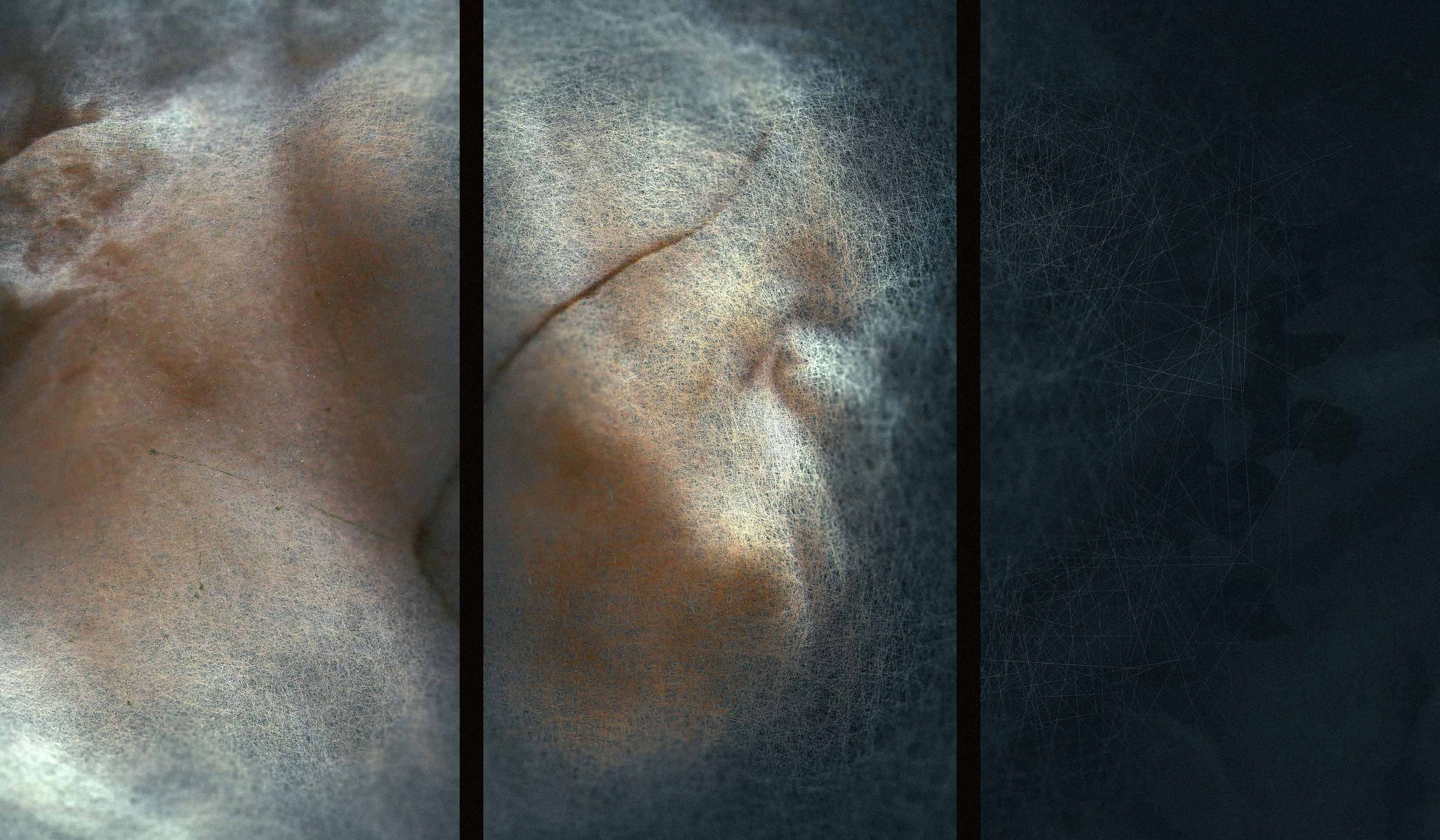
OpenEndedGroup’s art installation Maenads & Satyrs (2018) consists of three synchronized digital projections. The projections are on three eight-foot-tall screens arranged in the gallery as a triptych. The work has a running time of 13:40.
One of three works the artists created over the course of their extended residencies at the Isabella Stewart Gardner Museum (2013–17), Maenads & Satyrs derives from an extensive photographic survey they conducted of the Sarcophagus with Revelers Gathering Grapes. By means of their custom software platform Field, they first performed extensive analyses of the photographic data before utterly transforming it into the non-photorealistic stereoscopic 3D imagery of the work.
The soundtrack is a specially commissioned recording of the cellist Yeesun Kim performing Kaija Saarioho’s musical composition “Petals” for Solo Cello and Electronics (1988). (fig. 1)
1. cut
What to do when you can’t tell whether you’re awake or dreaming? At a moment when you just can’t believe your eyes?
Follow the usual practice: shut your eyes. Then, after letting them rest and relax in the dark warmth of your eyelids—
Open them up again wide to see what you now see in the plain light of day. Is it the same fantastic spectacle or has the world gone back to normal?
Something of this impulse lies behind the unexpected cutting of Maenads & Satyrs, where each brief run of 3D imagery ends with an abrupt cut to black. It’s as if the montage closes and reopens your eyes for you every six to fifteen seconds, eighty-seven times in all. Each time, you’re jumped to a new take on what can be seen, with your vision slightly jarred and reset.
This writing will do the same thing.
2. Eyes touch
Watching stereoscopic 3D imagery is always a slightly uncanny experience, sometimes deeply so. Part of you remains aware of the peculiar thing your eyes are doing to conjure up that extra and illusory dimension of space.
Sometimes when a 3D object floats within your field of vision, it comes so close you imagine you can reach out and touch it. But of course you can’t. Or, rather, you can touch it only with your eyes, if I can put it that way, brushing against curves of light somehow suspended in the air.
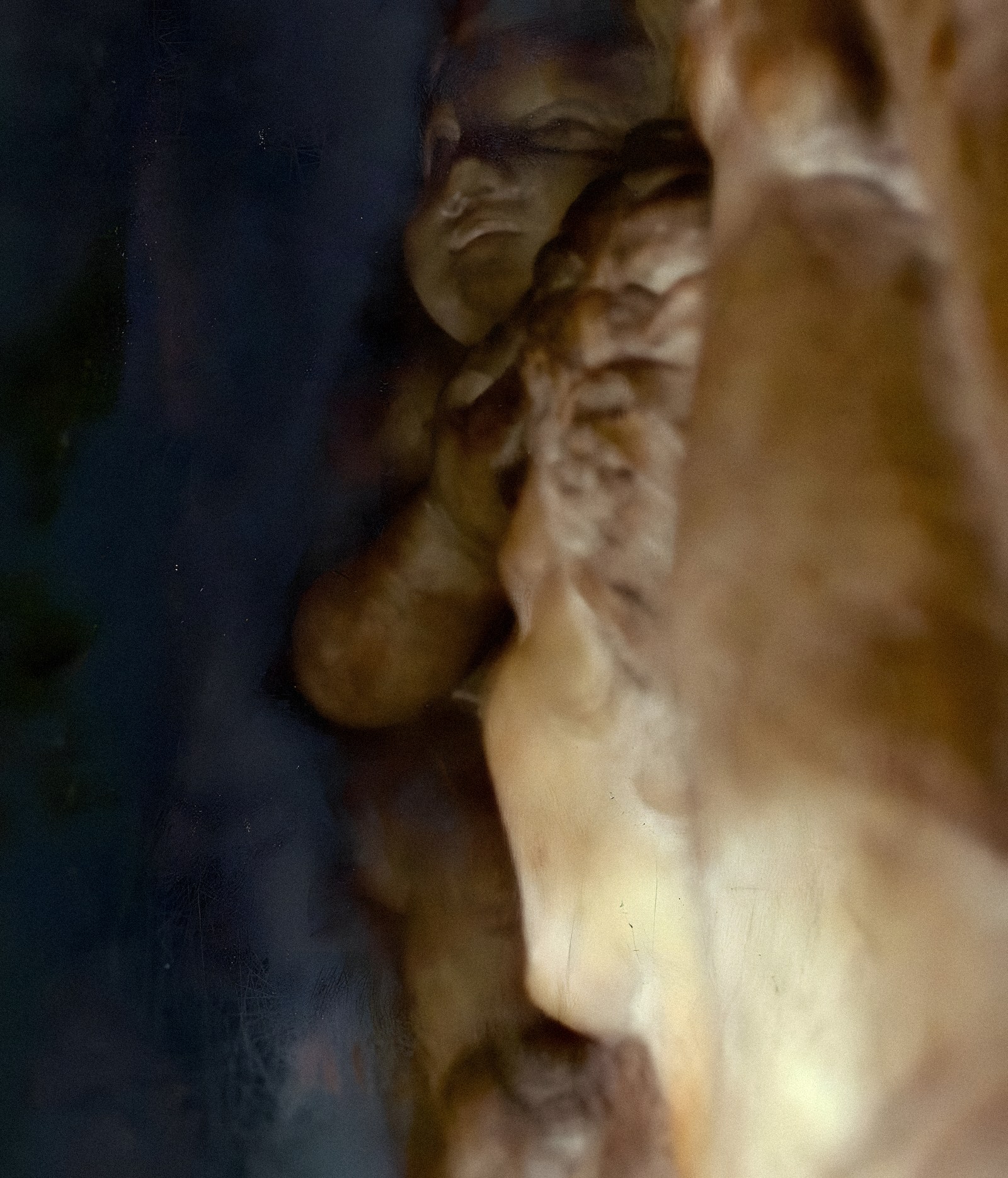
Maenads & Satyrs, 2018, frame 13591
As for your fingers, they pass right through the projection the way they would through a ghost. Or the way a ghost’s would through you.
3. Mediums
To evoke the afterlife, 3D projection is an ideal medium.
So is sculpting supernatural figures around the marble sides of a coffin.
Of course, many centuries separate the two art forms; their methods and materials have nothing in common, likewise their cultural contexts. But in each there’s a peculiar sense of the dead come back to life.
4. Art of the copy
When unearthed and displayed in Renaissance Rome, the second-century Sarcophagus with Revelers Gathering Grapes was an astonishing and unexpected gift from the past. Italian artists must have come first to gape at it; then they got down to work sketching copies. The hope was to get some of its secrets.
Their medium—drawing—reduced the sculpted figures to the flat picture plane of paper, where depth is reproduced only as illusion through shading, foreshortening, and so on.
Five hundred years later we, too, were mesmerized by the sarcophagus, encountering it in the atrium of the Isabella Stewart Gardner Museum.
We also tried grasping the marble figures by copying them. The likenesses we made were in our medium of the 3D moving image. Eventually we turned our copy into an original, Maenads & Satyrs.
5. Change your life
But who’s to say what’s the best medium for coming face to face with antiquity?
When I was a teenager, my first real encounter with the power of Classical art didn’t happen when I saw a sculpture in the gallery of a museum. No, it came when I read a poem in the pages of a book.
Sixty or so years before me, the German poet Rainer Maria Rilke had stood spellbound in front of an ancient sculpture. Even though I read his Archaic Torso of Apollo not in the original but in translation, it had me spellbound, too.1 Through the poet’s eyes I saw a headless Apollo “suffused with brilliance from inside, / like a lamp, in which his gaze, now turned to low, / gleams in all its power.”
And then imagined “a smile run through the placid hips and thighs / to that dark center where procreation flared.”
This idea of erotic seeing really spoke to me at that hormonal age, though it mystified me, too. When I faced the sarcophagus at the Gardner many years later, the poem came back to me again, still powerful, still perplexing.
But it’s strangest in its last two lines. In what remains of the Apollo, Rilke wrote, “there is no place / that does not see you. You must change your life.”
Yes. That’s how we should encounter such artworks—deeply and decisively.
6. Photography’s infinitude
Now the dominant medium of our age isn’t writing, and it isn’t drawing or sculpture. It’s photography. Photographs demand our attention wherever we look, whether at the real world or at our screens. Many millions of fingers are constantly itching to take more, and photographs shoot out into the world like the firing of neurons in a global brain.
Still, our eyes have dulled to their attractions. The impression a photo gives is so instantly replaced by the next one that it often registers as no more than a twitch.
And while the near infinitude of photographs we humans have been amassing is an astonishing thing to contemplate, it’s only networked computers—artificially intelligent and operating at incredible speeds— that can deal with that totality. They carry this out in the interests of government security agencies and of deep-pocketed advertisers. The sense they make of our pictures is a queer inhuman exploitative one: not aesthetic, not artistic, not spiritual.
7. The anti-photographic
In certain of our works, including all three at the Gardner, we’ve approached large sets of photographs with similar algorithms but opposite aims (aesthetic, artistic, and spiritual).
We do so anti-photographically, as you can see in all the stills reproduced here (despite their lacking the motion and threedimensionality of the originals). We’ve proceeded in our antiphotographic way with two aims in mind: to move beyond photorealism; and to free ourselves from any fixed framing.
Our approach, as it turns out, suits seeing the unorthodox Gardner Museum perfectly. Because, look, when you explore the collection,
how often do you encounter works that are strictly realistic? Take, for example, one of its masterpieces, The Rape of Europa, violent and erotic. Titian’s painting seizes you not only by its staging of Zeus as a bull abducting Europa but also by the artist’s stunning brushstrokes. Liberated by old age, Titian could paint with a free, fluent touch to bring out all the voluptuousness of Europa’s body and blur the landscape that rapidly dwindled below her.
8. Unframing
Titian did take care in framing his scene—true enough. But now step back in the gallery space and look around. Then wander through the adjacent galleries, peer out a window, go down the stairway, walk along a corridor, re-emerge into the courtyard. Wherever you look, you’ll find startling juxtapositions: Isabella Stewart Gardner’s specialty. Your eyes are drawn every which way between artworks—and also between windows and floor patterns and furniture and plays of light and shadow. A seemingly incidental view (a patch of red, the corner of a table, the shape of a bowl) can really transport you, sometimes (you may not want to admit this) as much as the masterpieces you came to see.
It’s all that visual interplay that struck us when we began our residency here. We found it a refreshing—no, an ecstatic—change from the contemporary approach of most museums, where artworks stand isolated in minimalist, noncontextual, and too often sterile spaces.
9. With abandon
At the start of our residency, Shelley Eshkar was still a partner in OpenEndedGroup, and, if you’d have followed him around the Gardner, you’d have seen him photographing the galleries at seemingly reckless speeds and from off-kilter angles. Usually not bothering to frame a subject through his viewfinder, he’d snap a dozen or even two dozen exposures per minute, raising the camera high above his head to clickclick-click a quick burst of shots, then lowering it to his feet to snap another burst. Taking half steps and pivoting constantly, he’d come in very close to a subject, then back far away, varying the distance, angle, and target as much as possible.
Eventually, between the three of us, we took more than 50,000 photographs of the museum. But we didn’t bother to look at more than a handful; instead we had our computers look—“look”—at them all.
10. Point-clouds
If you were to examine not just one but rather two snapshots of a space, you could ask yourself which parts appear in both. Subtract any parts that do not, and the intersection that remained would be the simplest example of what’s called a point-cloud. Add two, three, and eventually thousands more photos, and you can imagine (but not actually produce on your own) such a dense intersection of points that a stable view of the entire space would eventually emerge. You might be startled to realize that from these two-dimensional photographs, you’ve also teased out (by triangulation) all three dimensions of the original volume.
Since this takes millions of calculations, hand the task to a computer. Even then it’s a challenge. The algorithm you devise has to solve one jigsaw puzzle nested within another—and to solve each one at the same time. The first puzzle is to figure out the shape of the thing being looked at; the second, where each photograph was taken from. The algorithm will inch its way forward as it accepts or rejects a myriad possibilities, and after the power draw from your computer has caused a spike in your electric bill, eventually you’ll possess a credible (but not perfect) reconstruction.
That’s right—not perfect. But sometimes a few mistakes are a good thing.
11. Looking at looking
Our artworks often try to put you in a state of looking at looking. In pointclouds, this comes about like this:
Picture a camera hanging in space at the exact position and angle from which every given photo of a space was taken. Now imagine that you’ve turned each of those cameras into a projector. Rather than recording an image from incoming light, you’re projecting the image back out on the 3D point-cloud you previously constructed.
Those projected photographs hang in the space of the point-cloud in all their different positions, sizes, and angles. Were you to go look through a projector’s lens at the particular photograph it’s projecting, the photo would cohere; but when you stepped away again, the image would start to come apart. Before it did, however, you’d see both the picture and the point it was projected from, giving you a ghostlike vantage point on your own past perception.
12. Spirit vision
Spirits are said to walk through walls—to float up past ceilings, sink down through floors. Surely they can also see through any such barriers, immaterial to them as they are. If a ghost were to haunt an old museum, you might imagine her hovering on the other side of a gallery wall; when you look at a painting, maybe she’s looking at you through the back of it.
This isn’t literally the situation we evoked in Saccades, the second of the three works we made during our extended residency, but it dramatizes the sense we were trying to convey in it—of a collection that is looking at itself along all the paths eye vision goes in its galleries [phrasing?]; and of spaces that somehow foresee us as viewers within them. It’s a cliché to talk about a founder’s “guiding vision,” but in the case of Isabella Gardner’s vision, it’s embodied in her museum, and you feel her to be present in her absence.
13. Rapid eye movement
Saccades: rapid eye movements that abruptly shift their fixation point. Which our eyes perform, for instance, whenever we glance around a room or are dreaming.
It’s those two examples of saccades that made the word so apt a title for our film. For Saccades immerses you in a series of rapid glances through the spaces of the Gardner, often taking as it goes the unexpected leaps of the dreaming mind. Shots aren’t smooth and continuous; instead, they jump rapidly from vantage point to vantage point in a scattered stepping-stone progression.
To help you, we blink Saccades by inserting single black frames at key moments. The blinks somehow ease your way across sudden gaps in a sequence, letting you follow right along when it takes longer leaps across time or space.
14. Gothic/Titian
On the third floor of the Gardner, the Gothic and the Titian Rooms lie on opposite sides of courtyard, and so you can’t step to and fro between them—there’s no opportunity to make a direct visual comparison. You’re likely to gather only a sense of the different atmospheres in each one. In the third section of Saccades, we cross-cut between the two rooms. It’s the simplest algorithm for cutting we devised for any part of the film, and so the easiest to illustrate and explain. The cutting just goes back and forth between stills of the two galleries, blinking to black each time.
A couple of things emerged when we executed the program. First, since it selected whatever still came next chronologically, there was a phantom sense of the original photographer (presumably Shelley) as he stepped and stooped and pivoted through each room. Second, the paths he took through each room nearly matched each other, in a pleasingly rough, off-kilter way; and this brought out a curious mirror-image alignment between the two galleries—each had patches of the same red in its furnishings, a small devotional painting set upright on a little table by a window, and a longer table displaying a larger collection of objects. In the illustrated strip of frames, you can see the pattern of visual counterpoint as it emerges.
15. knight’s rest
Our first work at the Gardner was a short self-contained film, Knight’s Rest. The title refers to one of the things you see in it: the tomb figure of an armored knight, now in final repose in the Spanish Chapel. The quiet sense of mourning that imbues the chapel is said to reflect Isabella Gardner’s grief after she lost her only child in his infancy. The sense is reinforced when you learn of the instructions she left that her own corpse was to lie in state just outside the chapel, posed the same way as the knight.
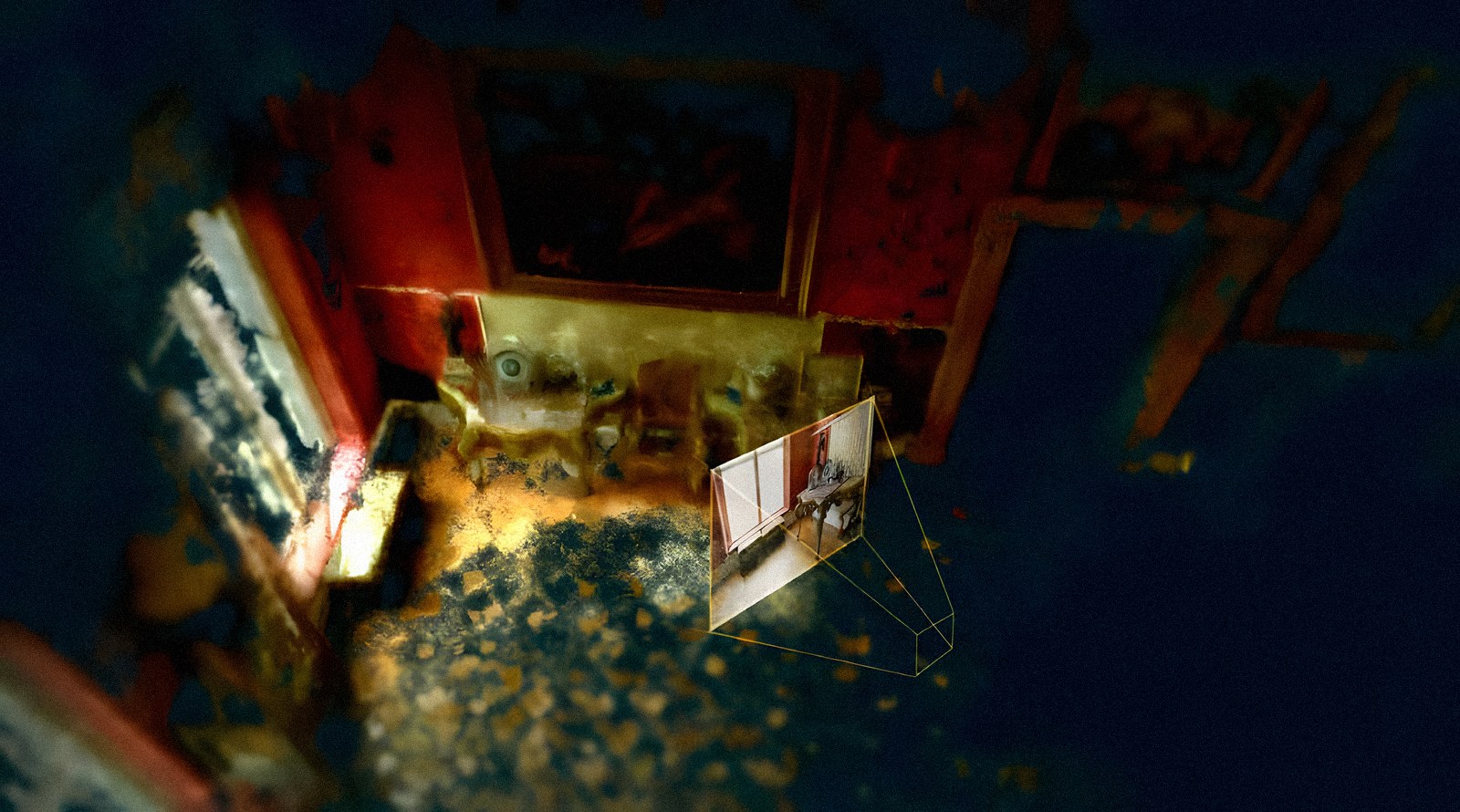
Saccades, 2014, frame of preliminary study

Saccades, 2014, selected frames from 60908–61408
Knight’s Rest is a variation on the chess term knight’s move—the L-shaped path taken by the knight across a chessboard: one square forward and two squares sideways (or two forward, one sideways), leaping over any piece that happens to be in the way. The reason for that wordplay becomes clear only halfway through watching the five-minute film.
For the film emerges from a single continuous movement I made in the chapel. Video camera in hand, I took a few steps forward into the space, made a leftward turn to go six or seven short steps in that direction, and then backed out in an almost exact reversal of my movements. The take was part of an experiment we thought was unlikely to succeed, so I gave little thought to how I moved. Only afterward did we see I’d unconsciously traced a knight’s move in chess.
When advanced software analysis of the video frames surprised us by generating an excellent 3D point-cloud reconstruction, we could not only play out my original movement but also shift the virtual camera to angles otherwise out of reach—for instance, looking down into the small chapel from well above the ceiling. The virtual camera moves with my original hand-held touch and rhythm even when its path is displaced in space, so when it soars up halfway through the film it’s as if your soul has suddenly ascended and serenely gazes down on the world it’s momentarily abandoned.
16. Better than born digital
Born digital is a phrase that points, usually in wonder, at the younger generations for whom digital interaction comes as naturally as breathing. What unforeseen abilities might they have, what new mind-sets?
My colleague Marc Downie was born not quite digital and nowhere near any computer centers. But, by some uncanny law of attraction, he’d acquired the very first kind of personal computer by age six, a Sinclair ZX81, and there in his house at the edge of the North Sea he tried to make it do something. The Sinclair made him start from scratch—you had to program the thing. So he began writing code at that precocious age and hasn’t stopped in the thirty-plus years since.
He also explored every nook and cranny of his Sinclair, something you could still do with those early devices—they exposed their few parts to view. As for memory, his Sinclair had all of four kilobytes of it, so each bit of information it stored was precious!
Since the phone in my pocket has 33,742,500 times more memory, since its parts have been miniaturized to an unbelievable degree, and since you void the warranty if you open it up to inspect those parts— you’ll understand that, while kids today can do endless numbers of things with such a device, they have no chance to get to know its workings. So I’d give the older guy, Marc, the advantage over them.
17. Drawing
When you look at a charcoal drawing, you’re aware of its physicality, and you even make out in the marks made the physicality (and effort) of the artist. Look—over here you can see how the charcoal crumbled slightly as the artist leaned into an emphatic curve; and over here how she or he gently smudged a much finer line with a fingertip.
In a great drawing, you’re aware both of the marks on the paper and of the picture they form. There’s no contradiction there; those dual perceptions don’t divide and diminish your experience, they intensify it. The art of drawing gets its power from the artist’s encounter with the physical properties of his or her medium; so do painting and sculpture.
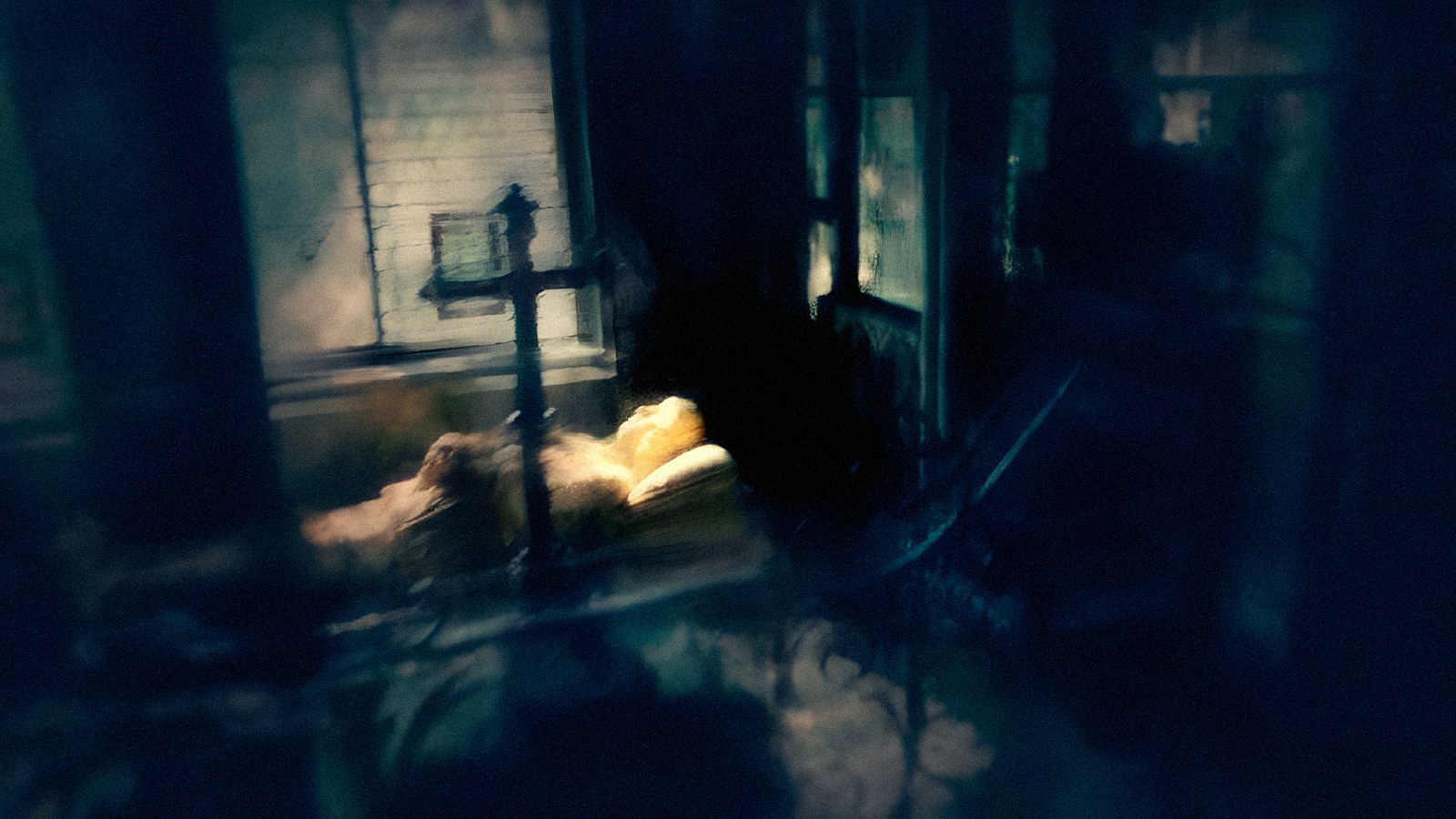
Knights Rest, 2013, frame 1457
18. False physics
A standard film frame currently has sixteen million colors in any one of two million possible positions, and a computer has no trouble switching each of these values in a tiny fraction of a second. As a medium, then, computer graphics would seem to offer no resistance; and, even if it did, its lightning calculations wouldn’t betray any efforts to overcome it.
Marc’s lifework has been to make a medium out of computer graphics, one that feels connected both to the real world and to the history of art. And so the codebase he’s built creates a consistent environment that obeys what he calls a “false physics.” Though its sets of constraints are different, they’re like the kinds of constraints we encounter in the physical world.
The non-photorealism of this invented medium evokes drawing and painting, but it also violates some of their rules with rules of its own. For example, it displays complex transparency in ways that painting can’t—as well as three-dimensionality, and movement, and near infinity of variation.
We’ve made nearly all our works in project-specific iterations of this invented medium, needing it not only for what it allows us to do but also for what it resists us doing. In our struggle with it, we alight upon unexpected imagery, entering visual realms we’d only dreamed of.
Our artworks often stage the challenge that went into making them. The images bear the marks of that struggle. As a viewer you can sense the effort and intention that are embodied in what you see—matched by the effort you feel yourself making to really see it.
Maenads & Satyrs also evokes the ecstatic struggle of sex. Its lines and colors caress; its transparency penetrates.
19. Dance
Figures carved in marble don’t move, of course. Likewise, anything captured in a point-cloud doesn’t move either: points not in the same relative position in two or more photos (like those moving in the time between shots) the algorithm disregards.
So it’s strange that we who are probably best known for our work in dance should have embraced a method that rules out moving bodies. It was worth the sacrifice, for it got us out of motion-capture studios and curtained studios and theater stages, sending us through the door into the world outside. There we made works evoking specific sites—places in upstate New York; an industrial ruin in Detroit; a few neighborhoods in Brooklyn. Oh, and the galleries of a special museum in Boston.
But on the sarcophagus, the figures are all caught in motion—they twist, they turn; they touch, pull, and lift. So their implied movements begged to be brought to momentary life. Which led to Maenads & Satyrs becoming in its own way our newest dance work.
20. Roving gaze
Roving gaze—sounds lascivious, doesn’t it? In Maenads & Satyrs our roving virtual cameras never stray far from the action; they almost touch the Dionysian figures in their sacred orgy. The camera seems to animate not just our gaze but also the sculpted bodies. They come to a kind of life.
There are six camera movements in all: four of them following carefully designed pathways, two of them following random ones.
Forgive more numbers—they give an idea of the wide net we cast. From the more than 3,000 photos I took, Marc successfully reconstructed 2,740 in the point-cloud. Seven hundred were compelling enough to render out, which we did in three different visual styles and with the virtual camera moving over them in the six different ways I mentioned. This gave us 12,600 takes, from which we created 255 triptych combinations. Of these, 89 ended up in my final edit.
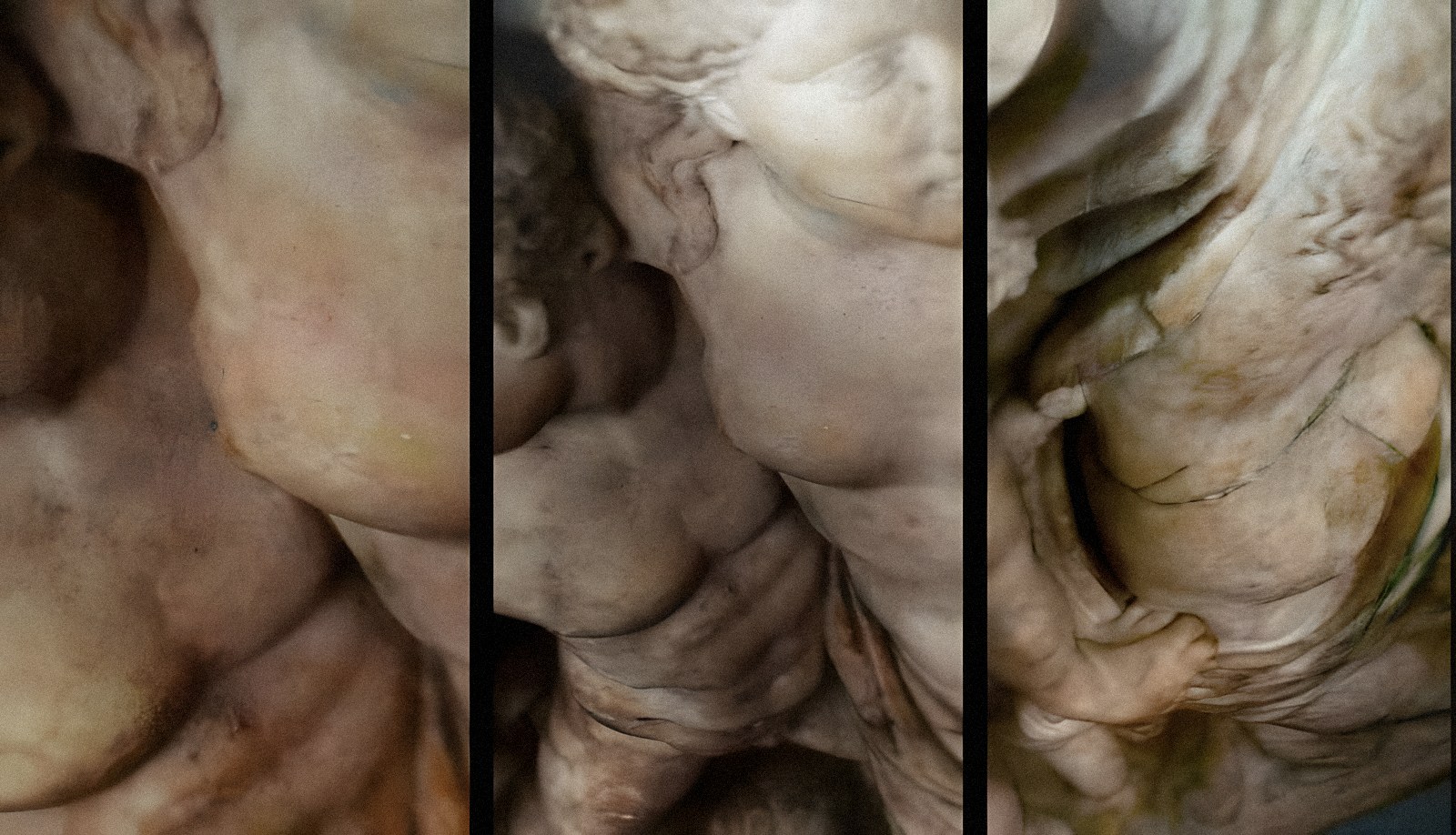
Maenads & Satyrs, 2018, frame 13373
Many triptych sequences have the camera, time-delayed, move the same way over the same views on all three screens. Others, however, have it move the same way over different views, or move differently over the same views, or move differently over different views. Lots of variation.
21. Afterimages
When Maenads & Satyrs hits its three vertical screens, the projections are very large, a foot or two taller than life-size. The pictures, in 3D, are always in motion.
When one of the sequences cuts to black, afterimages float in your eyes.
A different surprise lingers briefly in your body. It’s a feeling gentler than, but akin to, the hurtling forward you feel when your car brakes suddenly to a stop.
22. Accidents
Our method is to embrace any useful accidents. I’ll mention four kinds that we wove into the work.
First, errors in our point-cloud reconstruction. Here’s another figure: 12,537,384, the number of 3D points reconstructed. Perhaps 5 percent of these were stray mistakes, the most egregious easily culled. The remaining points tended to cluster in floating tendrils, displacements that duplicated nearby surfaces or edges. The eye reads them, nicely, as paint splatters or smudges.
The ravages of time are a different kind of accident. The sarcophagus figures have cracks, dirt, early nineteenth-century replacement parts— accidents that re-emerge meaningfully in the image, where on the one hand they suggest scars, hair, abraded skin, and uncanny otherness, while on the other hand suggesting paint daubs, specks, sprays, and strokes.
There are also accidents of vision, which our imagery often tends to provoke. Momentary optical illusions like this one:
A raked view downward fills the screen with a man’s muscular torso and butt. As the camera rotates our view slightly, we recognize our error—it’s the man’s leg we’re looking at, for what we thought was his torso was his knee, and his calf, his butt. This jolt to our vision also seems to jolt its object: we now seem to see the vitality coursing through the marble limb.
The last accident I’ll mention concerns how we encountered the sarcophagus in the first place, coming upon it in the Gardner atrium. Its placement there seemed the only major lapse in Isabella Gardner’s vision. She’d rested it low between two pillars, giving very little room for the figures on either side. But what could we do? We accepted the placement as a given, and we let it shape our inexpert, unscholarly, intuitive reading of the figures.
23. Womb/tomb
Peering into the dark little recess on the left side, I made out (and my camera then captured) an infant seen in profile, staring off into a space I couldn’t see. In the work, as the virtual camera peers in at his face, he seems to float in the snug near-darkness. A little later, we look down into the recess and spot the face of another baby. This one, also with wideopen eyes, is lying prone; his features are curiously more Buddha-like than Roman.
A cut, and now we’re gazing down at the baby’s tiny legs resting on the stone. Doesn’t this make it seem as if he’s been laid to rest in a crypt?
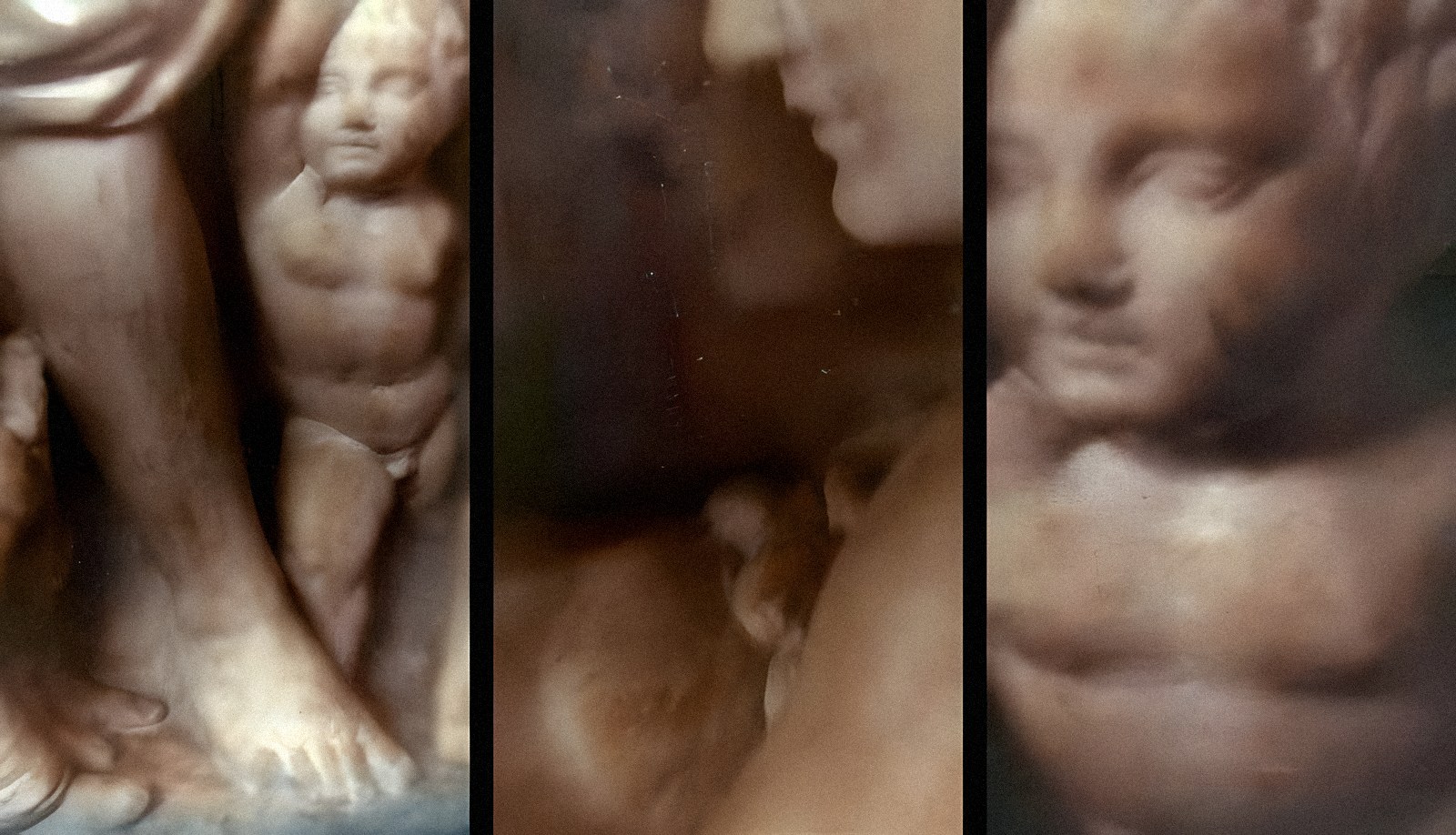
Maenads & Satyrs, 2018, frame 12073
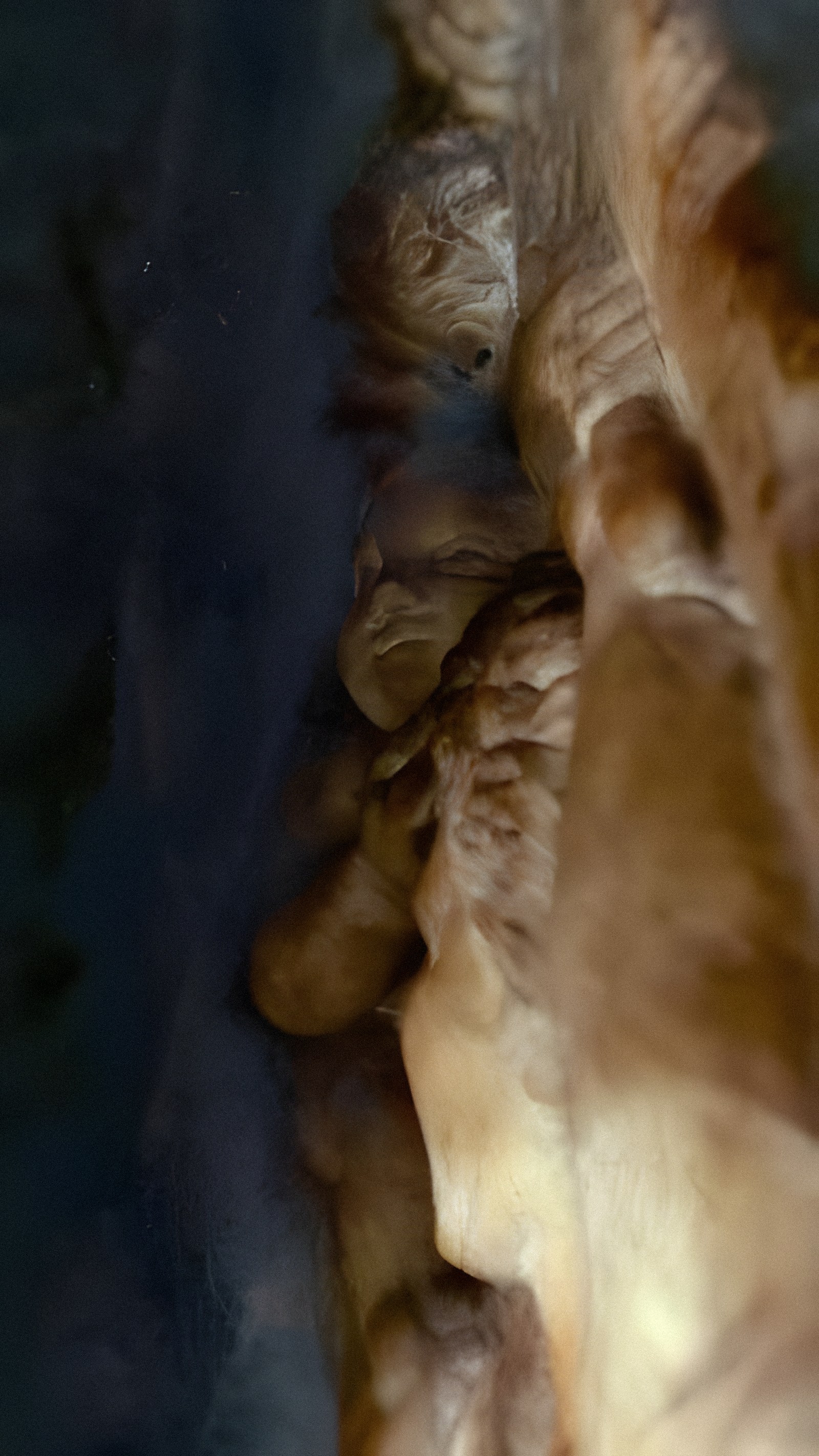
Maenads & Satyrs, 2018, frame 17068
Withdrawing our gaze a bit, we brush against a woman’s flank: his mother?
Further out comes the torso and then the scarred face of a man: her lover? Cut, and we’re closer to his face, panning across his neck and jaw and cheek. His ear comes into view, very strange. It’s an elongated crescent of an ear, reminding us that he’s not one of us but is of another race and realm. Unearthly ones. 24. Touch Lots of kinds of touching on the sarcophagus. Even the touch of a woman’s tasseled belt on her rounded midriff gives an erotic charge, not to mention the touch of hands clasping a bare shoulder or pulling clothes off a bottom, or off a back, or off a thigh.
What’s more, the projections themselves seem to caress what they show us, for isn’t there a sensual touch to be felt in the delicate stroke of a line as it curves over the body it’s conjuring up? 25. Cello The musical score for Maenads & Satyrs came at the impeccable suggestion of our cellist, Yeesun Kim, after she watched a preliminary version of the work several times through. Composed by Kaija Saarioho, it’s called “Petals” for Solo Cello and Electronics. Cello was always what we had in mind for Maenads & Satyrs; cello with electronics aligned the music even more closely to the work.
Of all instruments, a cello resembles a human body most. Not only in the curves of its wood but also in its resonant interior and the chest-like warmth it imparts to the timbre of its notes.
In recording Yeesun, we positioned our microphones close to her so that traces of her moving body would register in the sound. Which puts another invisible presence hovering near you. As the music emerges under the touch of her bowing, her beautifully modulated strokes rhyme with the arcs of the cameras in motion.... 26. Eyes The figures connect through erotic touch, of course, but perhaps even more so through erotic sight. The ensemble is animated by an active interplay of eyes, and these range in look from adoring to impassioned to lewd. There are momentary glances as well as gazes held long and steady—there are gazes returned and others one-way....
Our impressions of them shift. A satyr looks to be a lecher when seen in profile, leering at the woman next to him. But cut to a different angle, his face now full-frame, and his gaze seems rather to yearn and implore.
Elsewhere—how odd!—down among the feet and legs of the lovers we see onlookers or witnesses: cherubic children (and one panther), gazing up puzzled or intrigued at the erotic play above. Sometimes their foreshortened views find their approximation in the raked angles of our roving camera, so should we wonder whether their looks and their interests are something like our own? 27. At the end Nothing’s answered. What’s hinted at you can barely touch.
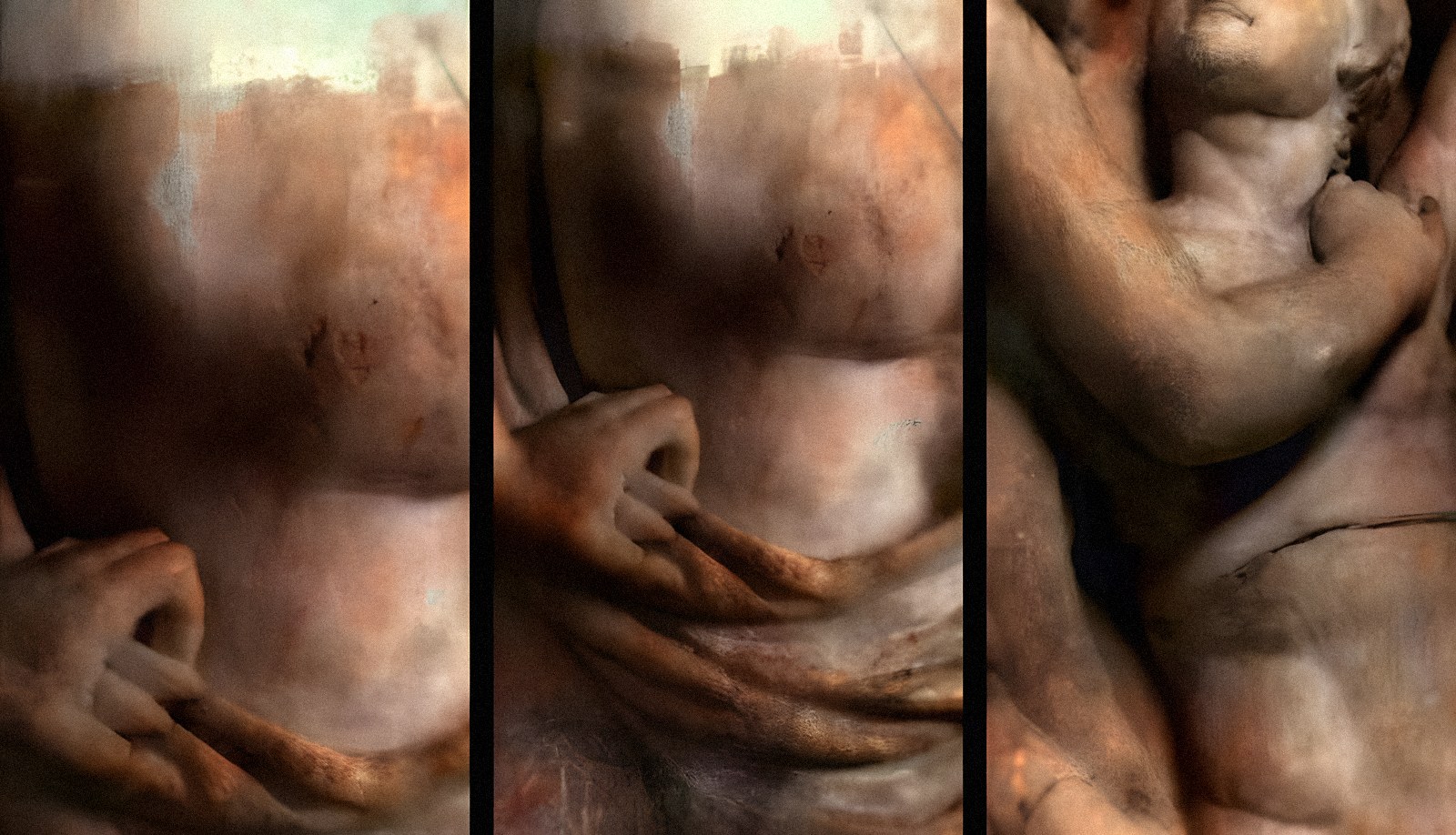
Maenads & Satyrs, 2018, frame 13591
Notes
- Rilke 1984, 61.