O—or, The Hazardous Lines of Sight
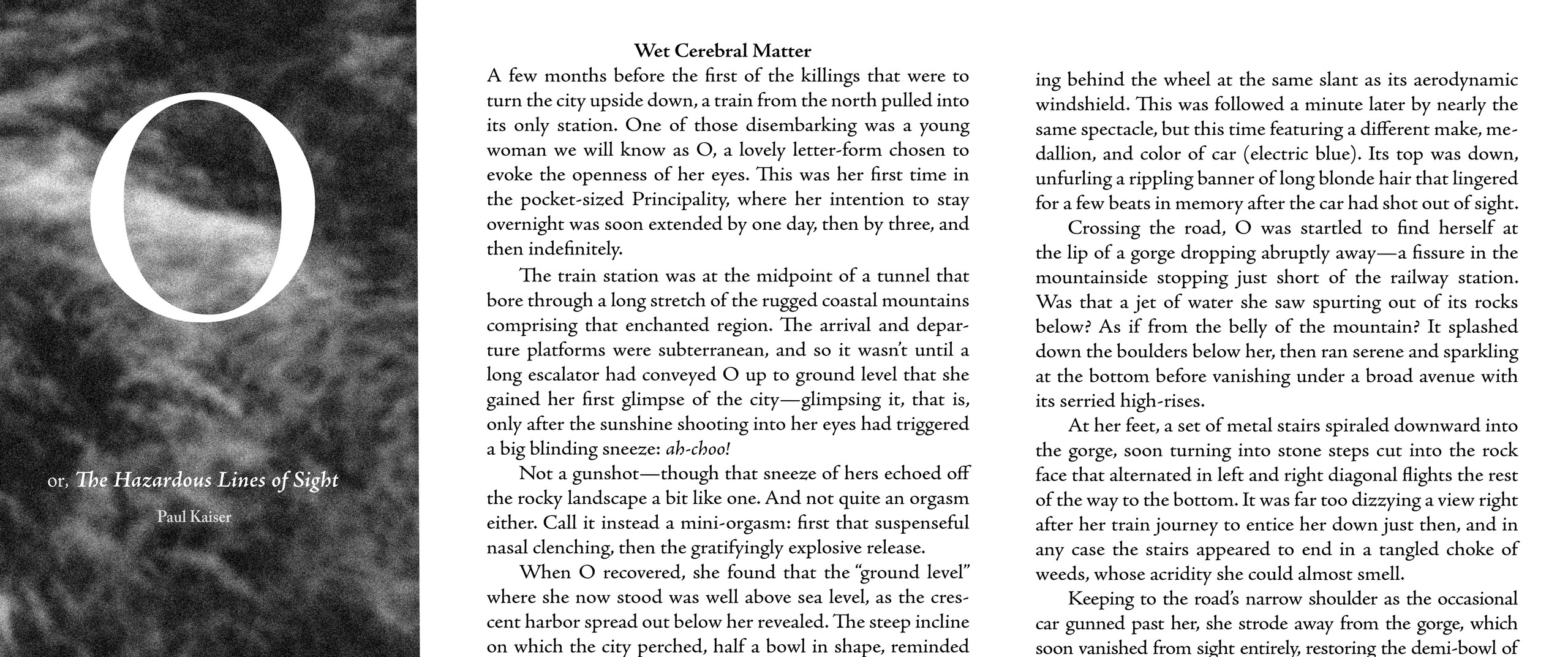
O—or, The Hazardous Lines of Sight looks at first like a detective novel, with killings, crime-scene photographs, an old detective, autopsies and a war-crimes trial. But it takes ever odder turns, one of which has its heroine vanish from sight for the whole first half of the story. She is known only as O, a letter-form evoking the openness of her eyes, and much of the story’s action consists of acts of perception. The novel even ends with a selective index devoted mainly to the forms and processes of perception. It tracks, for example, twenty-two distinct kinds of glimpse.
The title names the book’s real subject: every line of sight can be a line of fire. A sniper’s aim, a paparazzo’s lens, a laser dot on skin, a glance that impales: looking is power and violation, and perhaps also justice, or retribution.
Each clue makes the mystery larger rather than solving it. The killings lead back to the siege of a city a few decades earlier, then to atrocities in a far northern forest a generation before that. The weapons are of a kind no one has heard of. The killer may not be a person at all but a malevolent system, natural or artificial, spreading like roots underground and filaments in the air. As the mysteries deepen, the novel itself comes apart, and neither its characters nor its reader nor even its narrator can tell delusion from revelation, or second sight from the approach of death.
Most of the book is set in a small Mediterranean principality of high-rises, stairways, and a palace on a rocky promontory rising above the city. It also reaches north to a coast of fens and dikes, a snowbound mountain town, and a forest near the Arctic Circle, where aspens ring the graves of murdered girls. In time it runs from a medieval fortress through a world war, a divided country, and a city under siege, to a present of wireless signals and drones.
O is the only book Kaiser has written straight through rather than assembled from separate pieces—and the only one in which he impersonates a novelist.
Though completed in 2021, it first appeared (in substantially revised form) in a compact private edition in 2025.